Why Recovery Takes Longer After 40: The Hidden Role of Stem Cells in Women’s Healthy Aging
For many women, the first sign that something is changing isn't a hot flash.
It's recovery.
The workout that once left you feeling energized now seems to linger in the body for days. A stressful week takes longer to bounce back from. Sleep becomes lighter and less restorative. Muscle feels harder to maintain. Weight appears in places it never used to. Even the feeling of resilience—that quiet confidence that your body can absorb life's demands and recover—begins to shift.
Most of us are taught to think about aging in terms of accumulation. We accumulate years, experiences, and, inevitably, damage. We see the visible signs in our skin, our bones, our muscles, and our energy levels. Yet this perspective tells only half the story. The other half, and arguably the more important half, involves the body's extraordinary ability to maintain, renew, and repair itself.
This question sits at the heart of regenerative biology and has guided decades of work by stem cell scientist and STEMREGEN® founder Christian Drapeau. Long before stem cells entered mainstream conversations, he became fascinated by a deceptively simple idea: what if healthy aging depends not only on the amount of damage we accumulate, but also on the efficiency of the systems that continuously repair that damage? What if stem cells were a central component of the body’s repair system, and aging was, at least in part, the consequence of a gradual decline in the body’s ability to heal?
The human body is not a static structure. Every day, blood vessels are formed and maintained, immune cells are replenished, bone is remodeled, skin renews itself, and muscle recovers from the countless micro-stresses of daily life. In fact, we now know that every organ and tissue is constantly undergoing turnover and renewal. Even the heart, once believed to have little regenerative capacity, renews at a measurable rate throughout life. It changes how we think about health, wellness, aging, and disease formation.
Even while we sleep, maintenance and repair processes are quietly unfolding throughout the body. What appears stable from the outside is, in reality, a dynamic process of continuous renewal.
At the center of much of this activity are stem cells.
In many ways, stem cells are the biological link connecting repair, recovery, and healthy aging.
The Body’s Innate Capacity for Repair
Most people think of stem cells as an injection or therapy used in the context of injury or disease, but that framing misses their broader role. Stem cells, naturally released every day in the body, participate in the ongoing maintenance of tissues, contributing to processes of renewal, adaptation, and tissue integrity that occur throughout life. They support blood vessel health, bone remodeling, immune-cell replenishment, and countless regenerative processes that preserve tissue function over time.
This understanding led Christian Drapeau to focus on endogenous stem-cell mobilization—the body’s natural process of releasing stem cells from the bone marrow into circulation. These circulating stem cells become part of the body’s ongoing repair and maintenance network, responding to biological signals generated by tissues throughout the body.
That research ultimately led to the development of STEMREGEN® Release, a formulation designed to support the body’s natural release and migration of stem cells. Rather than introducing external stem cells, the goal is to support the body’s innate repair system by increasing the number of circulating stem cells available to participate in maintenance and renewal, naturally.
This perspective changes how we think about aging. The question becomes not only how much damage has accumulated through inflammation, oxidative stress, mitochondrial dysfunction, and environmental exposures, but how effectively the body is still renewing itself. For women, that question becomes especially relevant after 40.
Women and the Biology of Repair
One of the most important developments in women’s health is the growing recognition that estrogen influences far more than reproduction.
Estrogen receptors are found throughout the body, including the brain, cardiovascular system, bones, skin, connective tissue, skeletal muscle, and bone marrow. This widespread presence suggests that estrogen participates in a much larger biological conversation than we once appreciated.
In many tissues, estrogen helps create conditions that support repair and resilience. It contributes to vascular health, helps regulate inflammatory signaling, supports collagen production, influences bone remodeling, and appears to help maintain an environment that supports stem-cell function and tissue renewal.
For much of adult life, this hormonal environment may provide a meaningful advantage when it comes to recovery and regeneration. Estrogen doesn't simply influence individual tissues; it helps maintain many of the biological conditions that allow stem cells to participate effectively in repair and renewal. This may help explain why the menopausal transition can feel so significant. Sleep changes. Recovery changes. Bone health changes. Muscle maintenance becomes more challenging. Metabolic flexibility often shifts. While these changes often appear unrelated, many are occurring within the same stem-cell-dependent biological network.
Rather than viewing these as separate events, regenerative biology encourages us to see them as interconnected expressions of a changing landscape of repair and renewal.
Menopause and the Changing Biology of Repair
Menopause is typically framed as a hormonal transition. Yet it may be equally useful to think of it as a transition in the biology that supports repair.
As estrogen declines, inflammation often increases. Sleep becomes more fragmented. Vascular function begins to change. Bone remodeling becomes less efficient. Recovery from exercise takes longer. These shifts affect many of the same biological pathways that influence stem-cell activity, mobilization, signaling, and tissue regeneration. The cumulative effect is not simply a change in hormones, but a change in the conditions under which stem-cell-mediated repair takes place.
This perspective helps explain a common frustration. The same habits that once produced predictable results no longer seem to work in quite the same way. The body has not stopped responding. The biological conditions that support adaptation have simply changed.
Understanding this distinction shifts the conversation away from decline and toward support. The question becomes: how do we support the stem cell system involved in repair?
The Story Hidden Inside Bone Marrow
One of the most important shifts associated with aging takes place deep inside the bone marrow.
Bone marrow is far more than the material found inside our bones. It is a living tissue involved in blood production, immune function, skeletal remodeling, and the maintenance of important stem cell populations. Throughout life, marrow composition naturally changes. Red marrow, which is rich in blood-forming and regenerative stem cells, gradually converts in many areas to yellow marrow, which has little to no stem cells.
By midlife, the number of stem cells available for release from the bone marrow has declined dramatically compared to youth. Christian Drapeau often notes that by age 40, we may have lost as much as 90% of our stem cell reserves. While multiple biological factors contribute to this decline, age-related changes within the bone marrow environment appear to be an important part of the story.
Menopause adds another layer to these changes. Researchers have observed increases in marrow adiposity alongside shifts in bone remodeling and skeletal maintenance. Prior to menopause, estrogen helps support pathways that favor bone formation. As estrogen declines, the balance begins to shift, creating conditions that favor bone loss while reducing the regenerative support available to maintain skeletal strength.
The result is not that stem cells disappear, but that both aging and menopause influence the environment in which stem cells contribute to bone maintenance and repair.
This helps explain why bone health is about much more than calcium. Strong bones depend on hormones, circulation, mechanical loading, inflammation, and the stem cells that support continuous remodeling throughout life.
Why Strength Training Matters More Than Ever
This understanding also helps explain why resistance training becomes increasingly important after 40.
Bones are living tissues that respond to demand. When we walk, lift weights, carry groceries, hike, or challenge our muscles, stem cells within bone detect those forces and initiate adaptive responses. Mechanical loading helps maintain the signaling pathways that support bone strength and resilience.
Exercise also influences muscle repair. The cells traditionally known as satellite cells are now understood to be muscle stem cells. When muscle fibers experience the microscopic stress associated with training, these cells help coordinate recovery and adaptation. This process allows muscle tissue to rebuild, strengthen, and remain resilient over time. As estrogen declines, however, the environment supporting this regenerative process becomes less favorable, contributing to slower recovery and reduced responsiveness to training.
As the biology of repair changes, recovery becomes more important than ever. This is not a reason to exercise less. It is a reason to pay greater attention to the factors that support adaptation, including sleep, nutrition, inflammation management, and overall recovery.
In many ways, exercise serves as one of the body’s most powerful regenerative signals.
Sleep: The Forgotten Repair Window
If exercise provides the signal for adaptation, sleep is where much of the work of recovery takes place.
During deep sleep, growth hormone rises, inflammation becomes more regulated, oxidative stress is reduced, protein synthesis intensifies, and the nervous system shifts toward restoration. Many of the biological conditions that support tissue maintenance and recovery align during this period.
The body also operates according to circadian rhythms that help coordinate repair. Hormones, immune signaling, metabolism, and cellular activity all follow biological timing. When sleep becomes disrupted, these rhythms become less synchronized. Stem cell function declines, and recovery becomes less efficient.
This is particularly relevant during perimenopause and menopause, when sleep disruption often becomes one of the earliest and most persistent challenges. What begins as difficulty sleeping can gradually influence energy, recovery, mood, metabolic health, and overall resilience.
Poor sleep is not simply a fatigue problem.
It is a repair problem.
Supporting the Repair Journey
One of the most important lessons from regenerative biology is that stem-cell-mediated repair depends on more than the stem cell availability alone.
First, stem cells must be released from their reservoirs and enter circulation. There is a direct relationship between the body’s capacity for repair and the number of circulating stem cells available to participate in tissue maintenance and renewal.
Second, tissues must generate clear biological signals indicating where support is needed. These signaling molecules create the communication network that helps guide stem cells toward areas requiring repair and renewal.
Finally, stem cells must be able to reach those tissues efficiently. Healthy microcirculation and vascular function help support the delivery of stem cells throughout the body, allowing them access to the tissues where they may participate in regenerative processes.
This systems-based understanding became the foundation for the STEMREGEN® Repair Protocol.
STEMREGEN® Release was developed to support the natural release of stem cells from the bone marrow, helping increase the number of circulating stem cells available to participate in the body’s innate repair processes.
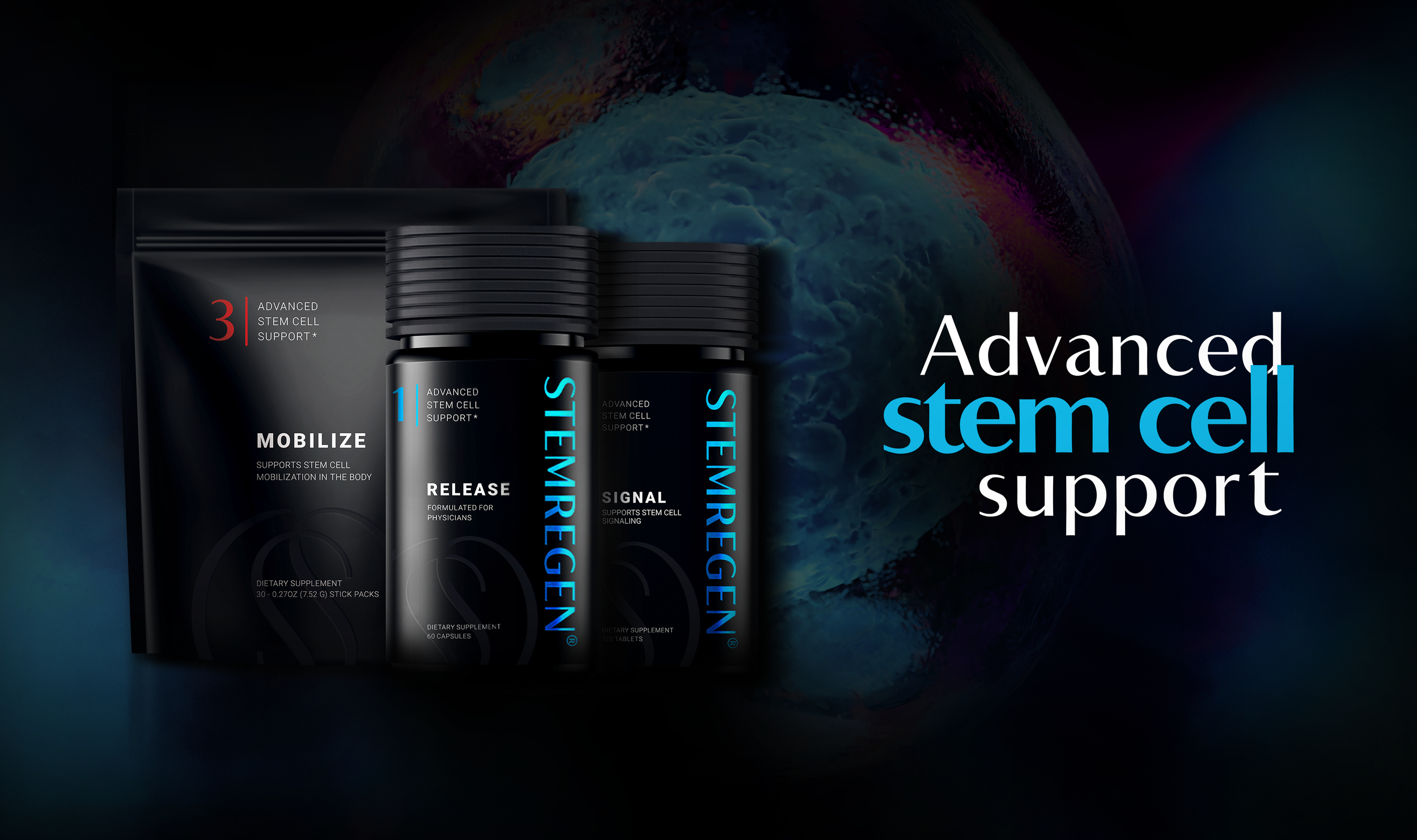
STEMREGEN® Signal was developed to support the cellular communication pathways that help guide stem cells toward tissues signaling for repair and renewal.
STEMREGEN® Mobilize was developed to support healthy microcirculation, capillary function, and endothelial glycocalyx health, helping maintain the vascular environment that supports stem cell delivery throughout the body.
Together, these three components reflect a systems-based approach to regenerative health: stem cell release, cellular signaling, and delivery to tissues throughout the body.
The Future of Healthy Aging
For decades, the conversation around aging and women’s health has focused almost entirely on damage. We talk about wrinkles, bone loss, muscle loss, cognitive decline, and disease. Yet beneath all of these changes lies another story: the gradual change in the body’s ability to repair and renew itself by the functioning of stem cells.
This is why recovery matters.
Recovery is more than bouncing back from a workout or a poor night’s sleep. Recovery is a window into the biological systems that renew every organ and tissue throughout life. When recovery changes, it may be one of the earliest signs that the systems supporting repair are changing as well.
For women, this perspective can be especially powerful. Many of the changes associated with midlife—from shifts in sleep and muscle maintenance to changes in bone health, metabolism, and resilience—can be viewed through the lens of regenerative biology. They are not isolated events. They are connected expressions of a changing repair biology.
The encouraging news is that these systems remain responsive throughout life. Stem cells continue to be released. Tissues continue to generate signals. The body continues to adapt to movement, nutrition, sleep, and the countless inputs that shape health and vitality.
The goal is not to chase youth.
The goal is to support the biological system that makes renewal possible: the body’s innate repair system driven by stem cells.
Because healthy aging is not simply about avoiding decline.
It is about preserving the body’s remarkable ability to repair, adapt, and renew itself for years to come.
Want to learn more about supporting your body’s natural repair system?
Explore the STEMREGEN® Repair Protocol and use code NAT15 to save 15% on your first order.
Shop STEMREGEN® ➡️ http://www.stemregen.co/nat
Promo Code: NAT15